
Blue Marlin Logo
Compare · White-label vs. freelancers

A great freelancer is a great find.A great system is a better one.

Freelancers are how a lot of agencies start outsourcing. Then a deadline lands on the one person who's also on vacation, sick, or fully booked. Here's how a white-label studio and a freelance developer actually compare, side by side.
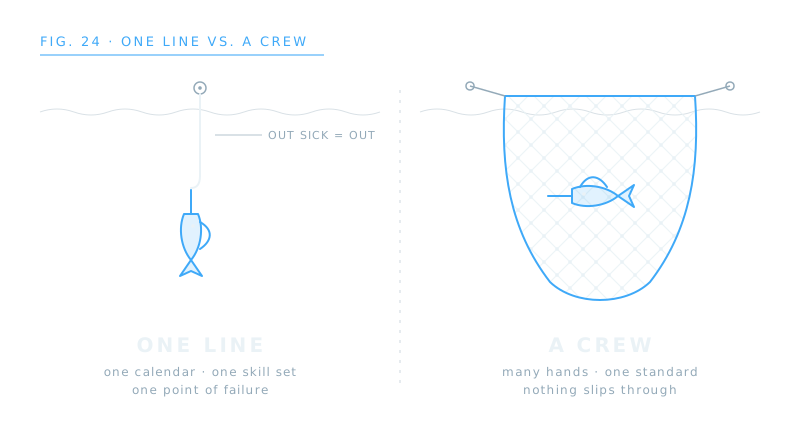
Surface · The honest version

Freelancers work until the week they can't.

Freelancers are a real option, and plenty of agencies run on them. If you have one dependable developer, steady work for them, and clients who never need anything in a hurry, that can work for years.
The trouble is structural. A freelancer is one person. One calendar, one skill set, one laptop, one point of failure. When your pipeline doubles, or the developer takes a full-time job, or the site needs a Core Web Vitals fix and a WooCommerce checkout and a migration in the same month, you're not managing a vendor. You're managing a risk.
A white-label studio is built for the week that goes sideways.
White Label vs Freelancers
Mid-water · The comparison

White-label vs. freelancers, side by side.

Same brief. Two ways to staff it.

Freelance developer

Blue Marlin (white-label studio)

Capacity
One person's calendar. Busy season means a waitlist.
A team. Reserved monthly capacity available on a retainer.
Continuity
If they leave, get sick, or take a job, the knowledge leaves with them.
Documented builds, full Git history, and the same team behind every project.
Skill range
Usually strong in one or two areas.
Build, WooCommerce, migrations, speed, accessibility, SEO, analytics, and email under one roof.
Quote & scoping
Varies by person; often hourly and open-ended.
Fixed quote within 48 hours of the brief.
Visibility into progress
Depends on the individual's habits.
Weekly staging links and async updates in your channel.
Quality standard
Whatever that person's standard is, project to project.
One written spec sheet on every build: lean Breakdance builds, minimal plugins, accessibility pass, security hardening.
Handoff
Often a zip and a "good luck."
Code, hosting, licenses, and docs transferred to accounts you own. Every plugin explained.
Confidentiality
Contract-dependent; a solo freelancer may list you as a portfolio client.
White-label by default. We publish no client lists. We were never here.
Management overhead
You brief, chase, test, and re-brief.
You send the brief. We run the build.
Best for
Small, occasional, low-stakes jobs.
Client work you can't afford to get wrong, and steady pipelines.
Mid-water · Fair is fair

Where freelancers still make sense.

Use a freelancer when...

Being straight with you is part of the brand. A freelancer is probably the right call when:

  • The job is small, one-off, and the deadline is soft
  • You have a developer you already trust and they have room on the calendar
  • The scope is narrow, like one plugin tweak or one template change
Use a studio when...

A studio earns its keep when the work is client-facing, on a deadline, spans more than one discipline, or has to keep happening month after month.

Deep water · True cost

The real cost isn't the hourly rate.

What a cheap hour hides.

The re-brief

Every new freelancer starts from zero on your standards, your stack, and your clients. That onboarding time is billable, or it's yours.

The chase

Project management on the developer's behalf (reminders, status checks, test rounds) lands on your producer or your founder.

The gap

When the one person is out, work stops. Clients don't hear "my developer is unavailable." They hear you missed the date.

The rework

Code that works but isn't documented, isn't standard, or lives in an account you can't access gets rebuilt later, at your expense.
Deep water · Getting started

How switching works.

Keep your freelancer if you want. Start with one project.
  • You don't have to replace anyone. — Most agencies test a studio on overflow: a build the freelancer can't fit, a migration nobody wants to touch, a speed fix that's been sitting in the backlog.
  • The three steps are the same as on every service page: Brief → Build → Hand-off — Send designs, scope, and a deadline. Get a fixed quote in 48 hours. Follow weekly staging links. Take the hand-off under your own name.
The abyss · Why us

Enterprise pressure. Studio precision.

We cut our teeth on enterprise-grade launches — clients where a broken site wasn't a bug ticket. It was a headline.
Launch nights timed to the minute. Traffic spikes with no warning. Personal and corporate brands worth eight figures riding on a page load. That's the pressure this studio was built under — and it's why agencies trust us with the work they can't afford to get wrong.
48h
Quote turnaround
100%
White-label, always
0
Client lists published
The abyss · Why us

Frequently asked questions

It depends on the work. Freelancers are a good fit for small, occasional, low-stakes jobs. A white-label studio is the stronger fit for client-facing builds, tight deadlines, work that spans several disciplines, and pipelines that repeat month after month, because you get a team, a written standard, and continuity instead of one person's calendar.

Often the hourly or project number is higher. The comparison that matters is total cost: the time you spend re-briefing, chasing, testing, and reworking, plus what a missed deadline costs with your client. Blue Marlin quotes a fixed price within 48 hours of your brief, so you know the number before work starts.


Yes. Many agencies use a studio for overflow, migrations, speed fixes, or anything their freelancer doesn't specialize in, and keep their freelancer for everything else.

No. Quotes, staging links, handoff docs, and the accounts the site lives in are all under your agency's name. We don't contact your clients and we don't publish client lists.

You do. Code, documentation, hosting, and licenses are transferred to accounts you own, with full Git history. Nothing is held hostage.

Per-project builds include 30 days of post-launch support. For ongoing coverage, a White-Label Retainer gives you reserved monthly capacity and maintenance across past builds.

Yes. That's what "The Single Catch" is for. One build, fixed scope, fixed quote. Move to a retainer whenever it makes sense.

Go get the big one.

Tell us what you're pitching. We'll do the fighting — quietly, of course.